2-1 · The Major Scale as a Reference System
Step off the guitar for a few minutes. Using a piano keyboard — where every note lives in exactly one place — this lesson shows where note names come from, builds the C major scale from the W-W-H-W-W-W-H formula (worth memorizing), and untangles scale degrees (position within a scale) from intervals (distance in semitones). You'll see how every interval name — major, minor, perfect, the tritone — falls out of the major scale, so the naming system finally makes sense instead of feeling arbitrary. It's the reference grid the rest of the course is built on.
What follows is this lesson’s section of the Course Guide — you can read it here or in the full guide →
The major scale is the foundation of the language of music theory. To visualize it, it helps to step away from the guitar briefly and consider the piano keyboard. That might sound strange in a guitar course, but the guitar makes some things harder to see: the same middle C can be played in five different places on the neck, while on a piano every note has one and only one location. You don’t need to learn piano; the keyboard just makes the underlying structure easier to see.
The piano organizes the twelve notes of the chromatic scale into repeating groups of seven white keys and five black keys. The five black keys are subdivided into groups of two and three:

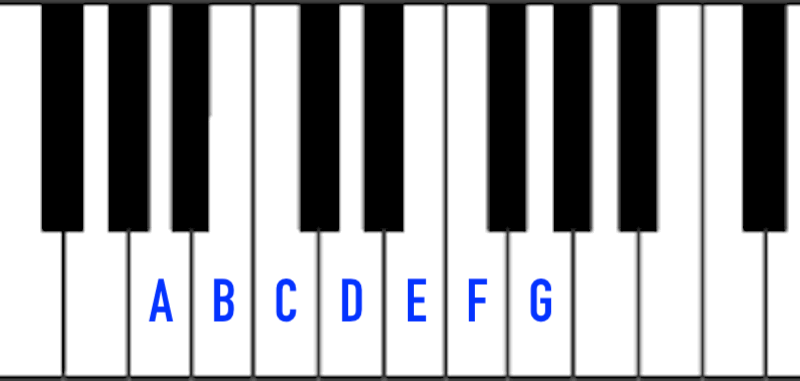
The names of the notes are based on seven letters that range from A to G, which all fall on white keys:
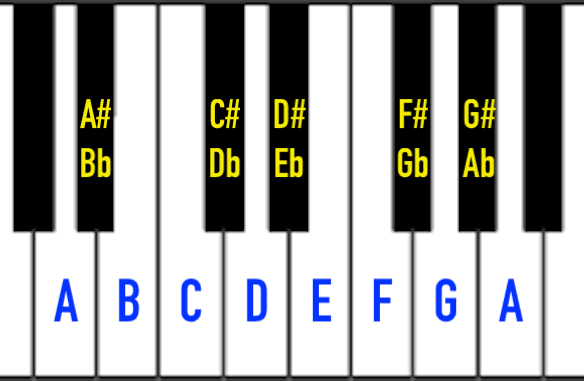
The black keys are named relative to their neighboring white keys, and each one has two names. The black key just to the right of a white key adds a sharp (#) to the white key’s name. The black key to the left of a white key adds a flat (♭).
Memorize this: The major scale is defined by a specific series of whole-step and half-step intervals. A whole step is two semitones (moving two adjacent piano keys on piano or two frets on guitar), and a half-step is one semitone. The major scale sequence is W-W-H-W-W-W-H:
The small numbers inside the black note circles are scale degrees, which denote the position of each note inside the scale.
It turns out that if you start on a C note on the piano and construct a major scale, it falls entirely on white keys. This means that the key of C Major contains no sharps or flats, which makes the C major scale on a keyboard a great visual reference. The name has two parts: C is the root, and major means the other notes are related to C by that specific set of intervals.
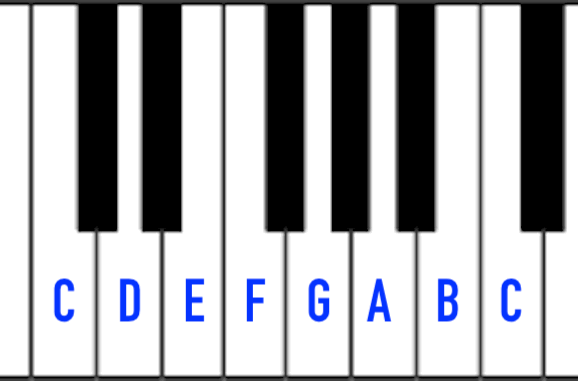
Scale degrees and intervals are related but different ideas. Scale degrees are positions inside a scale, always counted from the root: in C major, C is 1, D is 2, and so on up to B at 7, and then C is 1 again. Intervals are distances measured in semitones, and you can measure them between any two notes. There are twelve possible interval distances ranging from 0 to 11 semitones, and the intervals take their names from the major scale.
Discussion
Sign in to join the discussion.
No comments yet — be the first to start the conversation.