Blog · · Work in progress
Measuring the Vibrato of Nine Guitar Heroes
Vibrato is one of those essential techniques that clearly separates amateur from pro players. I've never been satisfied with mine. It's uneven, nervous-sounding, and it falls apart on bent notes. Part of the problem is that I've never had a clear picture of what good vibrato actually is, because it's often hard to hear an artist's vibrato clearly inside a mix. Advice online is easy to find, but a lot of it is vague, and some of it is wrong. The claim I hear most is that vibrato on a bent note only goes below the bent pitch: you bend up to the note, then let the bend off a little and push it back, never past the note you bent to. Of course, almost none of this advice is backed by measurements.
So I measured some. I took isolated guitar tracks from a handful of solos I love and ran them through pitch-tracking software to see exactly what the guitarists' fingers were doing. (I'm also building a tool to help train vibrato, and this is part of the groundwork. More on that soon.)
This is a first look, based on nineteen solos by nine players, so treat the numbers as a starting point. It's too small a sample size for any grand conclusions, but we can still learn a lot from it.
What we mean by vibrato
Vibrato is a regular wobble in pitch. On guitar, you make it by pushing the string sideways across the fret and easing it back, over and over. Three characteristics describe it:
- Width (or depth): how far the pitch swings, from the bottom of a swing to the top. I measure it in cents. 100 cents is a half step (one fret), so a 50-cent vibrato swings a quarter step and a 200-cent vibrato swings a half step in each direction.
- Speed: how many times per second the pitch swings up and back, in hertz (Hz). A 5 Hz vibrato swings five times a second.
- Delayed onset: how long a note is held straight before the vibrato starts. Some players shake a note the moment they hit it, and others let it sit for a beat first.
There's also the shape of the vibrato, which depends on whether the note is fretted or bent. A string can only be bent up, so on a fretted note, the vibrato swings up from the fret and back down to it, and never goes below. On a bent note, the player is already holding the string up, so the vibrato can dip under the bent pitch as well as rise above it. Whether it does is one of the things I tested.
How I measured it
Modern stem-separation software can pull a lead guitar out of a finished mix. The result isn't perfect, but it's often close enough for a pitch tracker to follow the notes. I tracked the pitch 200 times a second and corrected for each record's tuning (old records are rarely at exactly A440). Then I listened through every track and picked the vibratos that sound most like each player. Then, the software measured the characteristics of each note: how wide each swing is, and how many swings it makes per second. That gave me 150 vibratos:
- Ritchie Blackmore: "Smoke on the Water" (6 vibratos)
- David Gilmour: "Comfortably Numb," "Another Brick in the Wall (Part 2)," "Mother," and "Time" (43)
- George Harrison: "Something" (7)
- B.B. King: two recordings of "Every Day I Have the Blues," and "The Thrill Is Gone" (35)
- Brian May: "Bohemian Rhapsody" (9)
- John Sykes: "Is This Love" and "Still of the Night" (9)
- Eddie Van Halen: "I'm the One," "Jump," and "Unchained" (7)
- Stevie Ray Vaughan: "Couldn't Stand the Weather" and "Lenny" (20)
- Angus Young: "Back in Black" and "You Shook Me All Night Long" (14)
Two of my "vibrato" picks turned out not to be vibrato at all. More on those below.
How fast, how wide
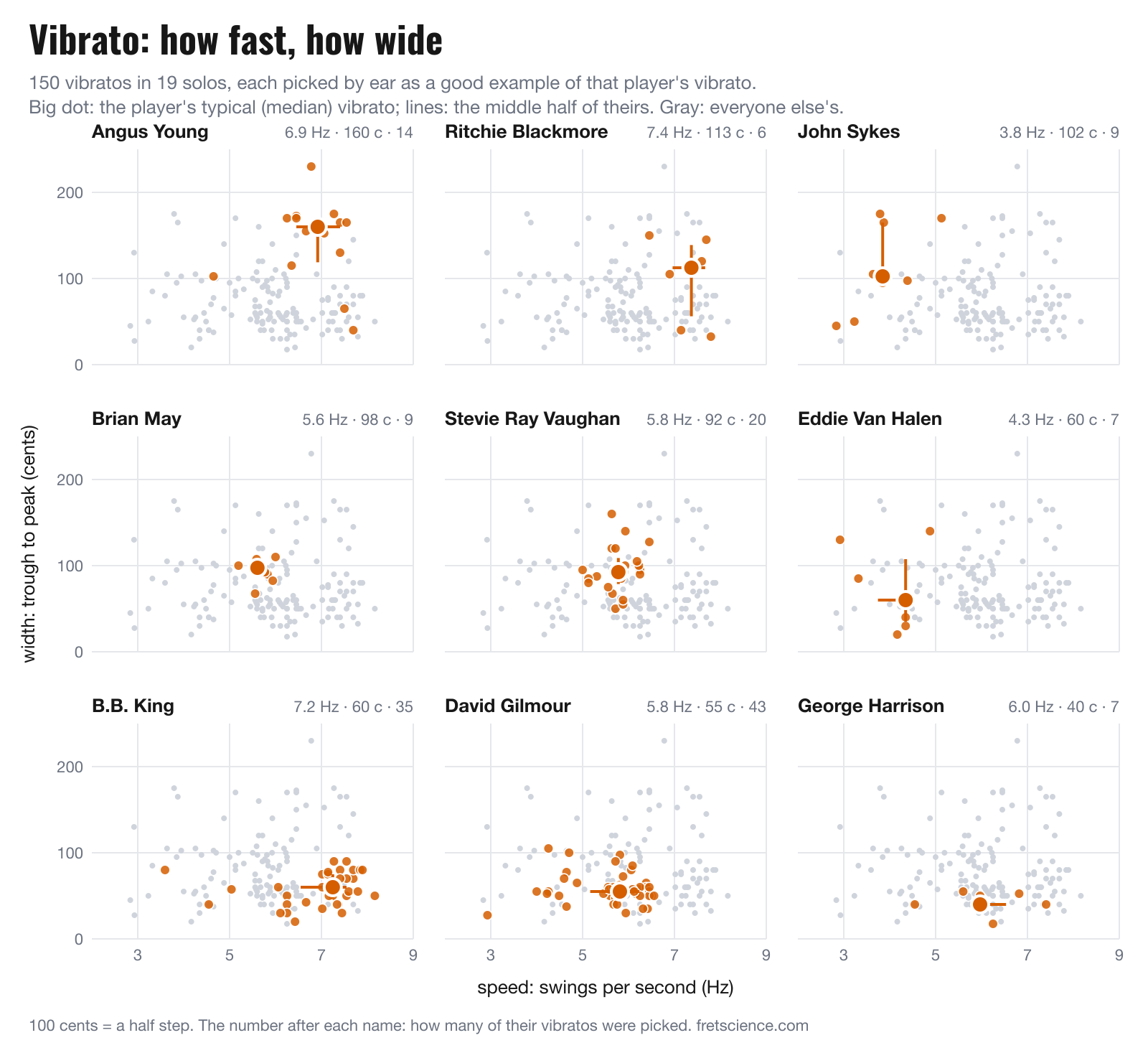
Each panel is one player: a dot for each vibrato, with everyone else's in gray behind it. The big dot is the player's typical (median) vibrato, and the lines span the middle half of theirs.
The difference I expected is there, and it's big. Angus Young's vibrato is nearly three times as wide as David Gilmour's, and about 20% faster:
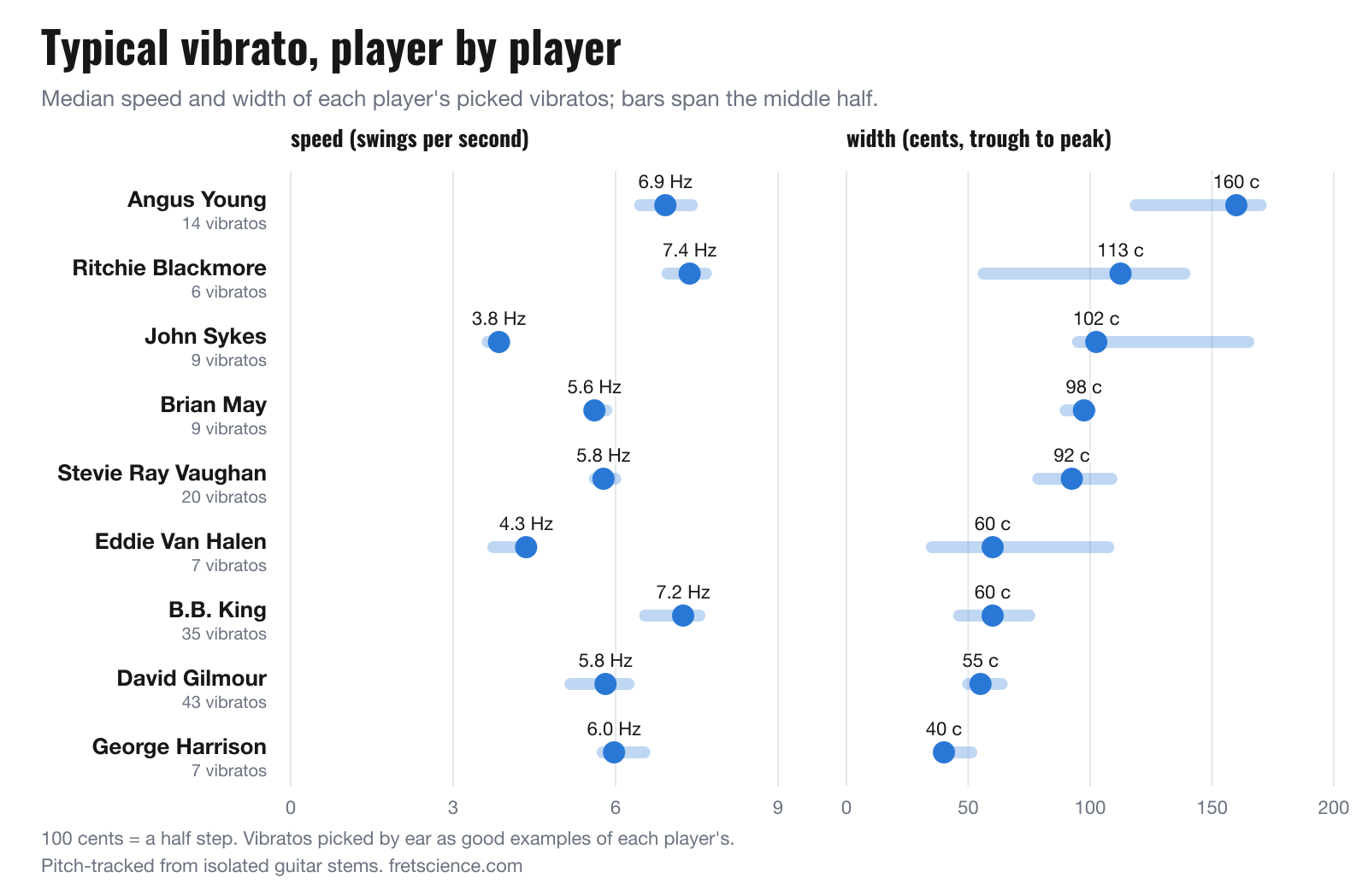
Typical vibrato, player by player.
Angus's typical vibrato swings 160 cents (more than three quarters of a step) at 6.9 swings a second. Gilmour's swings 55 cents (about a quarter step) at 5.8. The fastest belong to Blackmore, at 7.4 swings a second, and B.B. King, at 7.2. King's is also narrow, 60 cents, the quick, tight shimmer you hear all over his records. John Sykes is the opposite, wide and slow: 102 cents at under four swings a second. Harrison's is the narrowest of the group, a gentle 40 cents, which suits "Something."
The spread within each player is wide, too. Gilmour has fast, narrow vibratos and slower, wider ones, and Van Halen's run from a barely-there 20 cents to more than a half step. Partly that's because these are summaries of very different musical moments. A "typical" value doesn't describe every note.
What it looks like
Numbers only go so far. Here's one real vibrato from each player, fretted on the left and bent on the right, all on the same scale:
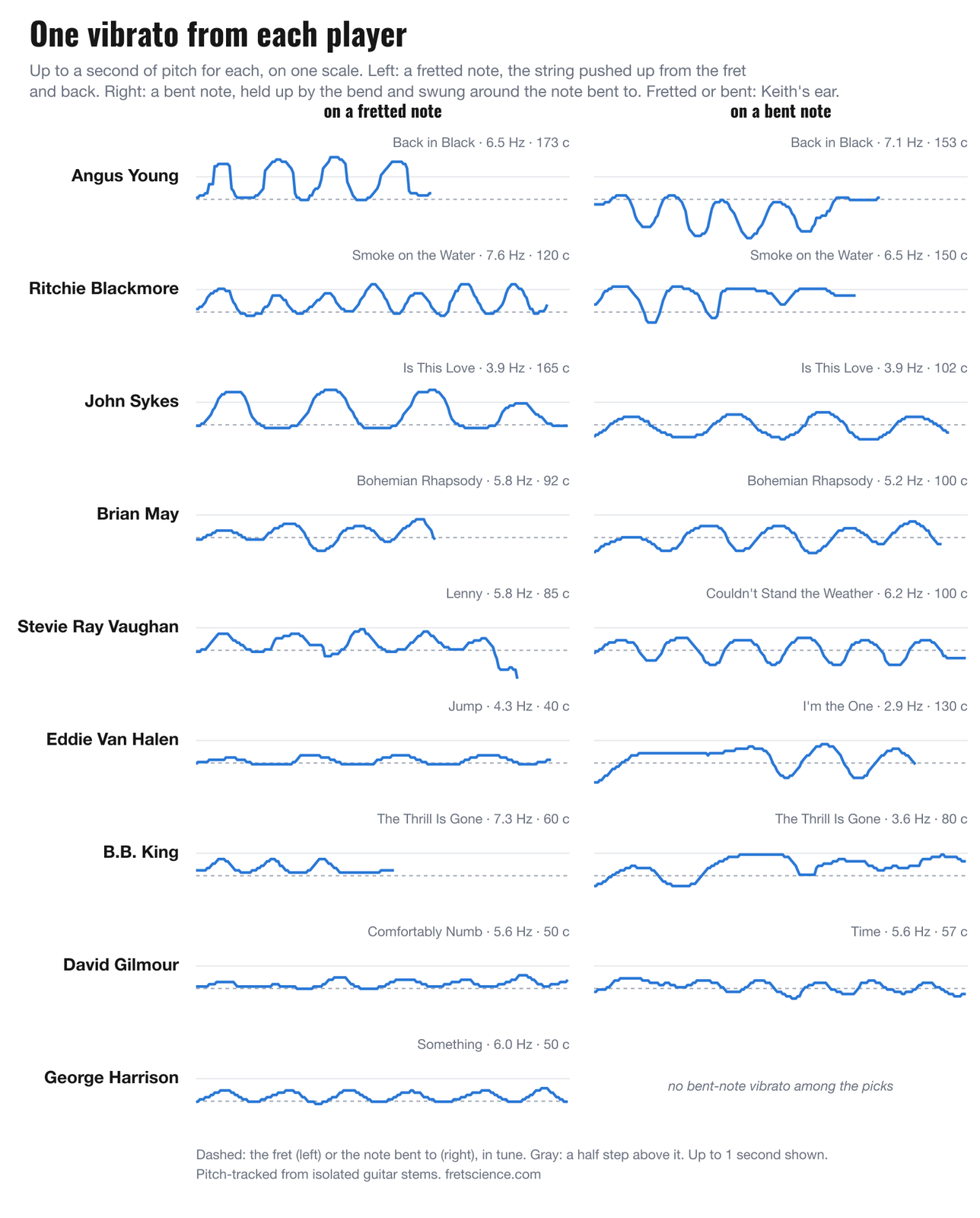
Up to a second of pitch from each player. The dashed line is the fret (left) or the note bent to (right), both in tune. The thin gray line is a half step above it.
The left column shows the fretted-note shape: every swing starts at the fret and goes up. On the right, the swings go both ways around the note bent to. Angus's bent-note vibrato in "Back in Black" dips more than a half step below the note he bent to, seven times a second. Gilmour's bent note in "Time" barely moves by comparison: about a quarter step from bottom to top, at five and a half swings a second. Harrison's row has no bent note, because none of the vibratos I picked from "Something" is on one.
I labeled 130 of the 150 vibratos fretted or bent by ear. For the other 20, I couldn't tell by listening, so the software decided from the shape: a vibrato that swings up from the fret and lingers there is on a fretted note, and one that rides above the fret and dips down from the top is on a bent note. On the 130 I labeled myself, that rule agreed with my ear 91% of the time.
Across all 150, fretted and bent vibratos come out about the same: 6.1 swings a second and 63 cents on fretted notes, 5.7 and 68 cents on bent ones. Within a player, there are hints of a difference. Angus and Sykes swing wider on fretted notes than on bent ones, while Gilmour's vibrato is the same either way. Most players have only a handful of bent notes among my picks (Gilmour has 14, the rest four or fewer), so that analysis may not hold up on a larger data set.
Does bend vibrato only go below the bent pitch?
If the claim from the top of this post were true, every bent-note vibrato would hang under the note the player bent to, its peak just touching the fully bent note. To check, I took the 23 bent notes among my picks where a clear bend comes before the vibrato, and measured each vibrato's swing against the note being bent to, in tune: the in-tune pitch nearest to where the player was holding the bend just before the vibrato started. That way, a player who overshoots a little or lands a little flat is still measured against the note they were reaching for.
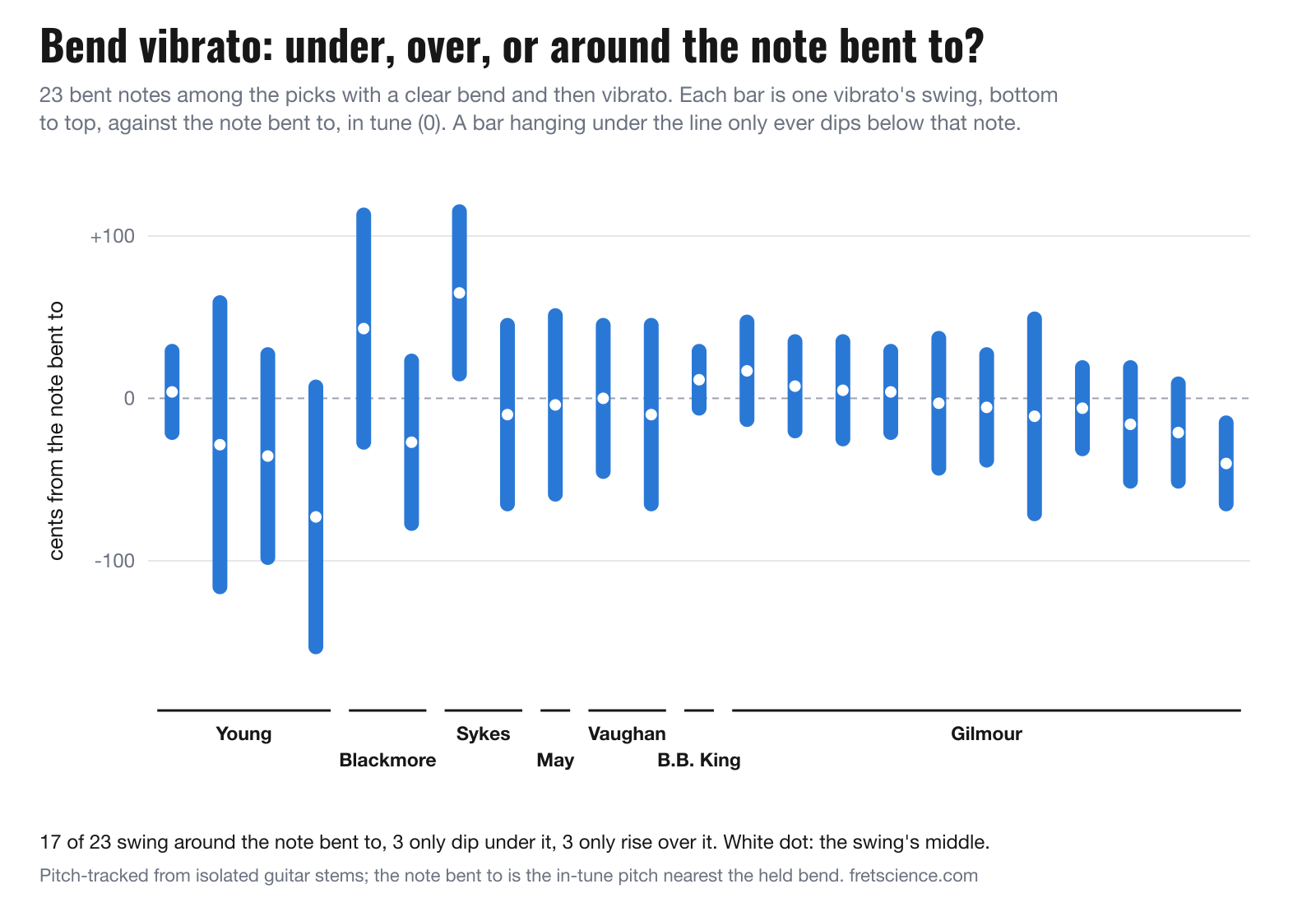
Each bar is one vibrato's swing, bottom to top. Zero is the note bent to, in tune.
Seventeen of the 23 swing around the note bent to, above it as well as below. Three hang under it, the way the claim says. The other three rise above it and come back down to it, but no lower. So "only below" isn't a rule, and in these solos centered is by far the most common shape.
I don't see a player difference here. Three of Angus's four bent-note vibratos swing around the note, and so do nine of Gilmour's eleven. There really isn't enough data to draw a strong conclusion either way.
Landing a bend in tune is its own skill, and these players mostly do it: half of the held bends sit within 13 cents of the note, and more of the rest are a little flat than a little sharp. Even when the bend itself is held off the note, the vibrato tends to center on it. Of the nine bends held 20 cents or more off, six still swing around the in-tune note.
Delayed vibrato
David Gilmour sometimes holds a note perfectly still and only then starts the vibrato, and so does Stevie Ray Vaughan. You can hear it in the "Another Brick in the Wall" solo, and the pitch tracks show it clearly:
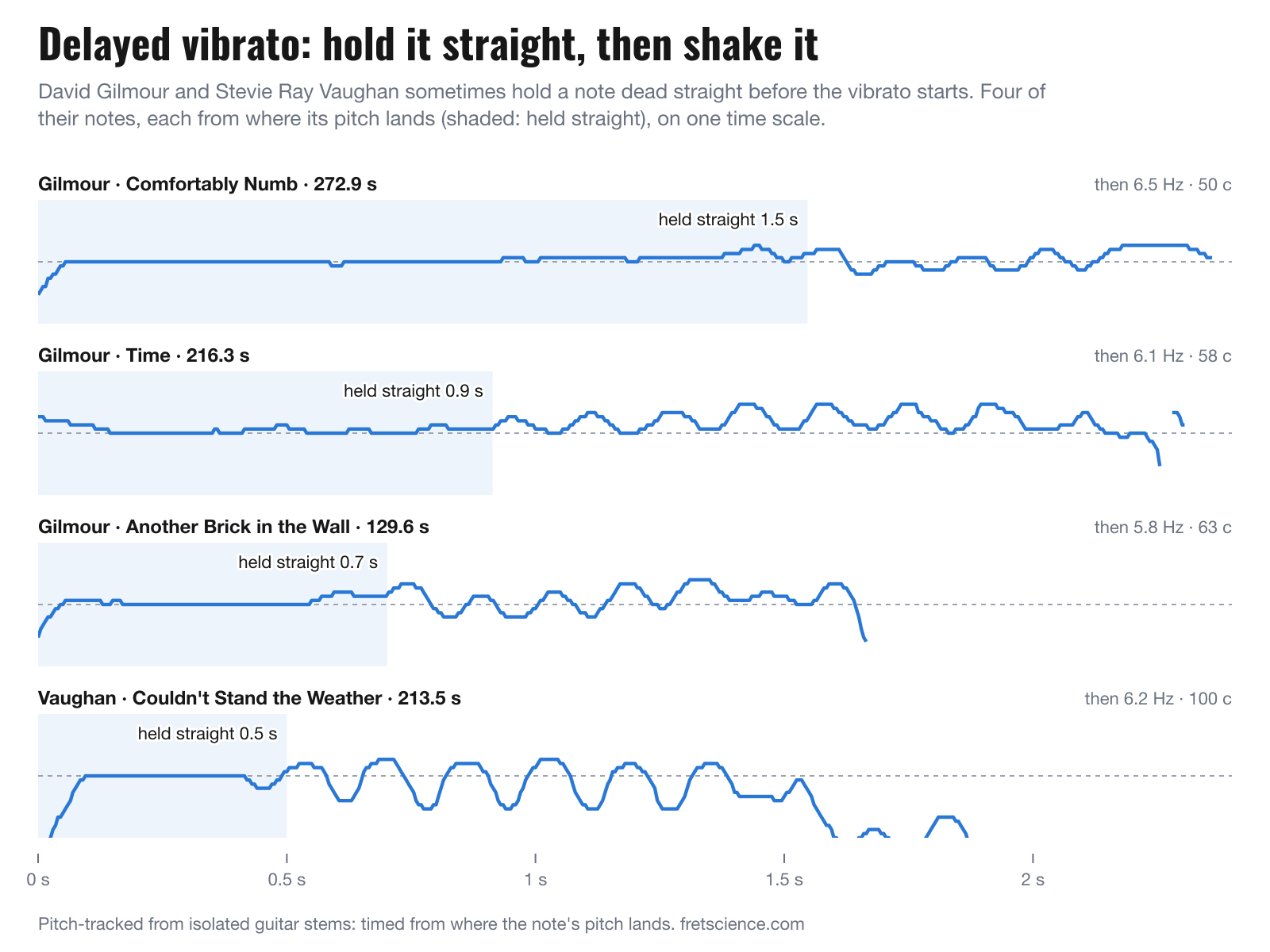
Four notes, timed from where each note lands. Shaded: held dead straight.
On the note from "Comfortably Numb," Gilmour holds the pitch dead straight for a full second and a half before the vibrato starts. Vaughan does the same on a held bend in "Couldn't Stand the Weather," for half a second, then shakes it hard. Holding a note still and then bringing the vibrato in is a technique worth knowing and practicing: it gives a long note somewhere to go.
Neither trill nor vibrato
Two of the notes I initially picked as vibrato turned out to be something else. In "I'm the One," Eddie Van Halen bends rapidly back and forth between two notes a minor third apart, about six times a second. In "Is This Love," John Sykes does the same across a half step, slowly, about twice a second. Both are continuous bends, like vibrato, but they move between two distinct notes, more like a trill. They aren't really either one, so I left them out of the numbers above.
The fine print
This is a preliminary investigation, and here is what could be wrong with it:
- Small samples: nineteen solos, nine players, and as few as six vibratos for one of them. Most of Angus's come from "Back in Black."
- Picked, not sampled: I chose every vibrato by ear as a good example of the player's. That favors clear, characteristic vibratos over every wobble on the record, so the numbers describe each player's vibrato at its most typical.
- Imperfect stems: stem separation leaves artifacts, and the pitch tracker can lose a note in the mix. Every measurement was checked against its pitch trace, and 11 picks were dropped because the tracker couldn't follow enough of their swings.
- Choices in the method: what counts as a swing, what counts as "held straight," and which in-tune note a bend is reaching for all shape the numbers. Different choices would shift them somewhat.
- Judgment calls: I picked the vibratos and labeled most of them fretted or bent by ear. The software labeled the other 20 from their shape.
What should I measure next?
This was a lot of fun, and I'd like to keep going with more players and more solos. Which guitarists' vibrato would you like to see measured? Leave a comment with the player and the solo if you have one in mind.
Credits
The isolated guitar tracks came from Moises, a stem-separation app. The pitch tracking uses the pYIN algorithm (Matthias Mauch and Simon Dixon, 2014) as implemented in LibROSA, the open-source Python library for audio and music analysis by Brian McFee and its contributors. I did the filtering and math with NumPy and SciPy, and used FFmpeg to decode the audio. The vibrato, bend, and timing measurements on top of that are my own code, written for this project.
Tagged: vibrato, technique, guitar heroes
Follow along by email
The newsletter goes out every other Tuesday with what's new at Fret Science, the occasional deal, and a roundup of recent blog posts. Unsubscribe anytime.
Prefer a feed reader? Follow the blog by RSS
Discussion (6)
Sign in or create a free account to join the discussion.
Very interesting! I say Publish!, at least in Guitar World magazine. I would love to hear the actual vibratos used in the analysis, maybe along with the waveform trace as they are being played. Looking forward to your vibrato tool!
Love John Sykes & also George Lynch's vibrato. Please measure George Lynch's vibrato - many great solos to choose from like 'Into the Fire', 'Unchain the Night' or 'Night by Night'
What a great experiment! I would like to see what Warren Haynes looks like. Maybe Soulshine OG on the Allmans album.
Jimi!
Any particular solos with standout vibrato?
I'm partial to Voodoo Chile. which starts with a vibrato note:
https://www.youtube.com/watch?v=qFfnlYbFEiE
I also love Little Wing but not sure how vibrato is featured in the latter.