Building Fretboard Fluency: The Big Picture
by Keith Martin
Introduction
Why does learning guitar require so much memorization?
Traditional guitar instruction forces students to memorize dozens of scale patterns just to play common scales in multiple positions on the fretboard. Want to learn the pentatonic scale? Okay, here are five scale shapes that fit together like a jigsaw, each with 12 notes to memorize. Want to learn the major scale? Okay, here are the five traditional in-position fingering patterns, each with 16 or 17 notes to remember. And you may also want to learn the three-notes-per-string version that the shredders use. There are seven of those patterns, each containing 18 notes to memorize.
And we haven’t even begun to consider other standard scales like harmonic or melodic minor, not to mention the modes of all these scales.
It shouldn’t be this hard!
At its core, the guitar fretboard is a simple grid, and patterns can easily be moved around, if you know the trick to dealing with the oddball tuning of the B string. The key to reducing memorization is understanding the building blocks of each type of scale and how they relate to each other.
For example, if you know how to deal with that tiny quirk of the fretboard, you can think of a pentatonic scale in terms of two simple shapes: one with four notes (the rectangle) and one with six (the stack). Armed with those two shapes plus a basic understanding of how they connect, you can easily play all five traditional pentatonic patterns without even thinking about it, and you can also move horizontally up and down the fretboard with ease.
Want to learn the major scale and its modes? Start by understanding how each mode relates to the pentatonic scale. Those five traditional in-position fingering patterns are as simple as layering two extra notes on top of the rectangle and stack in an easy-to-visualize way.
Understand more. Memorize less.
What this is: a library of mental models
There are dozens of different ways to think about the fretboard. Some are highly specialized solutions to specific challenges, while others are more general. At its heart, Fret Science is a collection of ways to think about the building blocks of music—chords, arpeggios, and scales— right on the fretboard itself, and this dramatically reduces the need for memorization.
If you already have mental models for some of these concepts, that’s great! But don’t be afraid to learn a new one alongside them. For example, you may already know all five pentatonic scale positions and how they connect. Still, if you understand the rectangle and stack method, you can leverage your knowledge to learn the modes more quickly.
In general, the more ways you have of thinking about a topic, the more ways you’ll be able to deploy it in practice. Does your understanding of the pentatonic scale allow you to play it up and down one string effortlessly? Or on a pair of strings? Does it let you effortlessly blend between the minor pentatonic scale and the Dorian mode? Do you see the close relationship between the Dorian and Mixolydian modes and how that informs almost all blues and rock music? Follow this approach, and you can do all those things easily.
As one of my mentors, Marvin Minsky was fond of saying:
“If you only understand something in one way, you don’t understand it at all.”
How does this relate to improvisation?
Improvisation is the art of spontaneously creating new music in the moment. When done in a group or with a backing track, it is the art of playing musical phrases that acknowledge and fit with or play against the harmonic and rhythmic context of the accompaniment.
Good improvisers know the chord progression and choose notes and scales that complement it. At any moment, the fretboard appears to them as a palette of note choices representing different musical colors or flavors. The improviser uses a combination of their ear and fretboard knowledge to create something new and different each time.
There are as many different approaches to improvisation as there are improvisers. One of the most well-known methods is chord tone soloing. In this approach, the improviser is aware of the position of the root of each chord, the locations of other chord tones, and the locations of additional scale tones and non-scale (or chromatic) tones.
This is an inherent hierarchy based on consonance: more consonant notes, like chord tones, will sound more stable and relaxed, whereas less consonant notes, like chromatic tones, will sound more dissonant, unstable, or unresolved.
One essential skill for improvisation is finding the root of an upcoming chord quickly, seeing nearby chord tones as likely target notes, and building a phrase using those and other tones from the hierarchy to achieve the desired level of tension and release.
This is the master skill for improvisation.
To get there, we need to be able to recall arpeggios and scales anywhere on the fretboard at a moment’s notice. Some of the best improvisers seem to do this purely based on instinct and a good ear, but we mere mortals can learn to do it, too.
It seems like a lot of steps
I occasionally hear objections to the methods described in Fret Science videos: it “seems like there’s a lot of math involved” or “there’s no way I can think about all of those steps while improvising.”
To the first objection: none of the “math” involves anything more complicated than counting by fives or subtracting twelve. If you can do that, you can learn everything in this method. Sometimes, it seems more complex than that because I tend to speak quickly, and I have a habit of jamming a lot of information into each video. The beauty of YouTube is that you can slow down the video to a speed that works for you and rewatch anything confusing. I also provide accurate transcriptions for all my videos, so turn on subtitles if that helps.
The second objection is more subtle. The straw man argument is that I’m suggesting that to play an A minor pentatonic scale, you will be forced to count fret by fret chromatically up the low E string to find the A at the 5th fret, and then you have to realize that you should play a rectangle shape there, which means that it must be a stack on the following string up. Then, you must remember to shift over one fret to play the rectangle on the top two strings. While I might describe that series of steps in one of my videos, that is not how I think improvisation works.
There is a vast difference between learning something for the first time and playing it fluently. My videos aim to give you mental models that you can store in your brain, allowing you to recreate chord, arpeggio, and scale shapes on the fretboard without referring to written diagrams. As you do this repeatedly over time in practice, your brain will get much faster at completing each step in the sequence and begin to skip some steps altogether. You will have internalized these patterns without explicitly memorizing them, and you will do this while making music instead of practicing scales.
What this is not
Fret Science is not a general guitar instructional method. It focuses on efficient ways to understand and internalize the fretboard’s unique geometry and learn to improvise solos over chord changes, all without needing to study jazz or go to music school.
In Victor Wooten’s book The Music Lesson, he describes musicianship as composed of ten components: Groove, Notes, Articulation/Duration, Technique, Emotion/Feel, Dynamics, Rhythm/Tempo, Tone, Phrasing, and Space/Rest. Of those ten areas, Fret Science has (so far) only focused on finding the right notes.
As Wooten points out — and I wholeheartedly agree — finding the right notes is only about 10% of what you need to make good music. So why only focus there? My goal is to give you a bulletproof foundation for that 10% in the quickest possible way so that you can focus your efforts on the other areas, which are equally challenging and ultimately more important.
What’s the story with the “cheat sheets”?
All Fret Science techniques are free to learn via my YouTube videos. For each video, I have created a printable cheat sheet that contains brief text and key diagrams for every significant concept from that video. The cheat sheets are optional, but many players have found them a convenient way to remind themselves of the key ideas when they sit down to practice.
Purchases of the cheat sheets are the primary funding source for creating new Fret Science content. Each one costs a few dollars, or you can buy the complete set for less than the cost of an in-person guitar lesson.
To purchase cheat sheets, visit https://shop.fretscience.com/. For a 10% discount on individual PDFs, use coupon code WELCOME10 at checkout. To get a sample cheat sheet for free, keep reading.
Elements of the big picture
The following is a guide to ten core Fret Science videos. Since many concepts build on each other, the videos are presented in my recommended viewing order. Feel free to skip around, but if you find something confusing, it may be cleared up by a video you missed.
The fretboard’s biggest quirk: the warp
The guitar is mostly tuned so that neighboring strings are five semitones (or frets) apart in pitch. But there’s a massive exception between the B and G strings, which are only four semitones apart. This exception makes playing open and barre chords much easier, but it makes it much harder to learn arpeggios and scales across the entire fretboard.
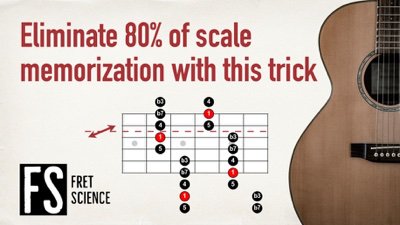
In this video, I introduce the concept of the warp,1 which is the key to reducing memorization. As an example, I show how the five traditional fingering patterns of the pentatonic scale can all be derived from one simple five-string pattern, as long as you take the warp into account. I also introduce the cycle of 4ths and 5ths and show how it relates to the fretboard. Finally, I show how to use this approach to target chord tones when improvising over the blues.
The pentatonic scale
The pentatonic scale is the most crucial concept for all budding improvisers to learn. It is by far the most frequently used scale in blues-based music.
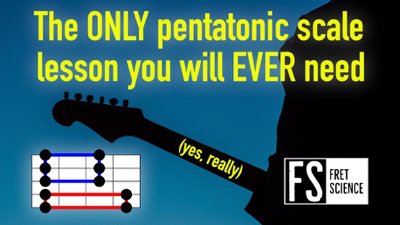
In this video, I introduce a new way to break down the pentatonic scale into two simple geometric shapes: the rectangle and the stack. By leveraging your understanding of the warp, this method makes it easy to visualize both the minor and major pentatonic scales and move horizontally, vertically, and diagonally around the fretboard. As a bonus, this video includes shortcuts for learning the blues and hexatonic scales.
I will probably make another video about the pentatonic scale someday, but this is the only one you need to be able to fluently play minor and major pentatonic scales up and down the fretboard.
I believe so strongly in this method that I want to give you the PDF cheat sheet for free. To get your free copy, create free account at fretscience.com and then visit this page.
Learning the names of the notes
For some reason I don’t quite understand, many guitarists never learn all of the notes on the fretboard. This is an essential skill if you want to learn to move freely around the fretboard and eventually learn to improvise.
In this video, I explain three reasons to buckle down and learn this essential knowledge, three mental models to help you move around the fretboard, and four practical exercises for remembering the notes thoroughly. I don’t often recommend memorization, but this is a rare place where it’s well worth it. And crucially, you won’t need to learn everything all at once before moving on to other topics.
Measuring distances with intervals
Intervals are the building blocks of melodies and harmonies. They are the fundamental way we measure distances between notes. As you learn to improvise, it will become increasingly important to know the musical function of each note inside a chord or scale, and intervals are the key.

In this video, I explain how to identify all twelve intervals and introduce a simple new method for determining the interval between any two locations on the fretboard.
The major scale and its modes
Guitar players talk a lot about the major scale modes, but few understand how they work.
In this video, I show how the seven modes (Ionian, Dorian, Phrygian, Lydian, Mixolydian, Aeolian, and Locrian) are derived from the major scale, and I introduce brightness ordering, which makes it easier to see how they relate to each other sonically and on the fretboard. I also show how the major modes (Mixolydian, Ionian, and Lydian) are built around the major pentatonic scale. Similarly, the minor modes (Phrygian, Aeolian, and Dorian) are built around the minor pentatonic scale.
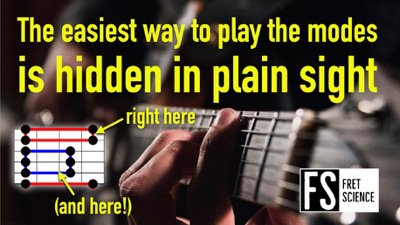
This video is probably my most significant contribution to guitar pedagogy. I demonstrate a simple way to layer the major and minor modes around the rectangle and stack pentatonic shapes. This makes it remarkably easy to move seamlessly between scales, providing a highly musical and easy-to-visualize hierarchy of notes that will improve your phrasing and note selection. I use this technique every time I touch a guitar.
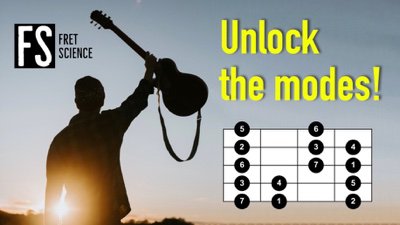
This video is optional but worth checking out. It shows that the traditional in-position fingering patterns for the modes are all built from the same underlying 5-string pattern. The more ways you have of thinking about these concepts, the deeper your understanding and the more flexible your playing will be.
CAGED vs. 3NPS: why not both?
The CAGED and three-notes-per-string (3NPS) systems are often described as competing ways to visualize the fretboard, but each has unique advantages that complement each other, so I highly recommend learning both.
At its heart, the CAGED System uses five open chords—C, A, G, E, and D—to map the entire fretboard. In this video, I show how to use the positions of the roots inside those five chords as a skeleton framework on which you can hang any music theory construct. The essential building blocks are triads, arpeggios, and scales, and they snap together like LEGO pieces. After the rectangle and stack, it is the most essential framework to master because it allows you to jump to a new location on the fretboard and immediately orient yourself.
While the CAGED system gives you signposts near your fingers no matter where they are on the fretboard, the 3NPS system gives you essential pathways for moving smoothly from one location to another using the major scale. This video provides a massive shortcut for learning 3NPS. Instead of learning seven 18-note fingering patterns, you’ll learn one 21-note pattern that covers the entire fretboard and strategies for using that pattern to move both horizontally and vertically.
Playing harmonized lines
Many classic guitar songs feature harmonized lines, and with the knowledge you’ve gained from the previous videos, you can easily create beautiful on-the-fly harmonies.
Using examples from Van Morrison, The Beatles, and Nuno Bettencourt, this video shows three ways to harmonize the major scale in thirds. These techniques are perfect to use as fills or to add depth to your solos. If you can play the major scale on one string and you know the difference between a major and minor third, you’re minutes away from improvising beautiful harmonies.
About the author
I’m an engineer by training and a musician by passion. I began my career studying signal processing (hoping to learn to design stomp boxes), but I later veered toward cognitive science, artificial intelligence, and the study of auditory perception. For my Ph.D. dissertation, I built an AI system that could identify orchestral instruments as well as humans can. I went on to work in the audio industry as a research engineer for 25 years before moving to my current job as a software engineering manager at a scientific software company.
Alongside all that, I have been playing guitar since the late 1980s. I took a couple of music theory electives in college and can read music competently, but for most of my life, I learned guitar parts from TAB. Over the years, I played in over a dozen cover bands and daydreamed about improvising and writing songs. Still, I always ran up against a wall, frustrated by needing to memorize countless scale patterns and arpeggios. I forgot to mention how much I detest memorization and repetitive practice.
About five years ago, after reading dozens of guitar books and watching countless YouTube videos, my computer science training finally connected with my music theory studies. I began to see arpeggios and scales as algorithms and data structures (nerdy, I know).
And that led me to see fretboard geometry in a new way. It’s deeply connected to traditional approaches like the CAGED system and 3NPS, but it takes them further. I discovered new methods to learn scales that required much less memorization and had the unexpected benefit of making scales sound more musical. I finally started feeling comfortable jamming and improvising solos over chord changes.
I’m still what I would call an “early intermediate” improviser, but I’m making faster progress than ever. And Fret Science is my attempt to share what I’ve learned. I hope these new approaches to understanding the fretboard will help you progress much faster than I did, and I can’t wait to hear what you do with them!
You can reach me at keith@fretscience.com.
Berklee guitar professor Jon Finn calls it “The Warp Refraction Threshold” in his excellent book Advanced Modern Rock Guitar Improvisation (affiliate link), but I prefer the shortened name.
↩
Discussion
Sign in to join the discussion.
No comments yet — be the first to start the conversation.