Guide
How to use the Melodic Sequence Explorer
The Melodic Sequence Explorer plays a melodic sequence through one position of a scale and shows it three ways at once: a fretboard that lights each note as it sounds, standard notation, and tab. In Complete Scale Fluency 6-2, a melodic sequence is two things: a pattern (a handful of notes) and a shift (the rule for where the pattern starts again). The Explorer has the common sequences built in, and you can write your own.
The controls
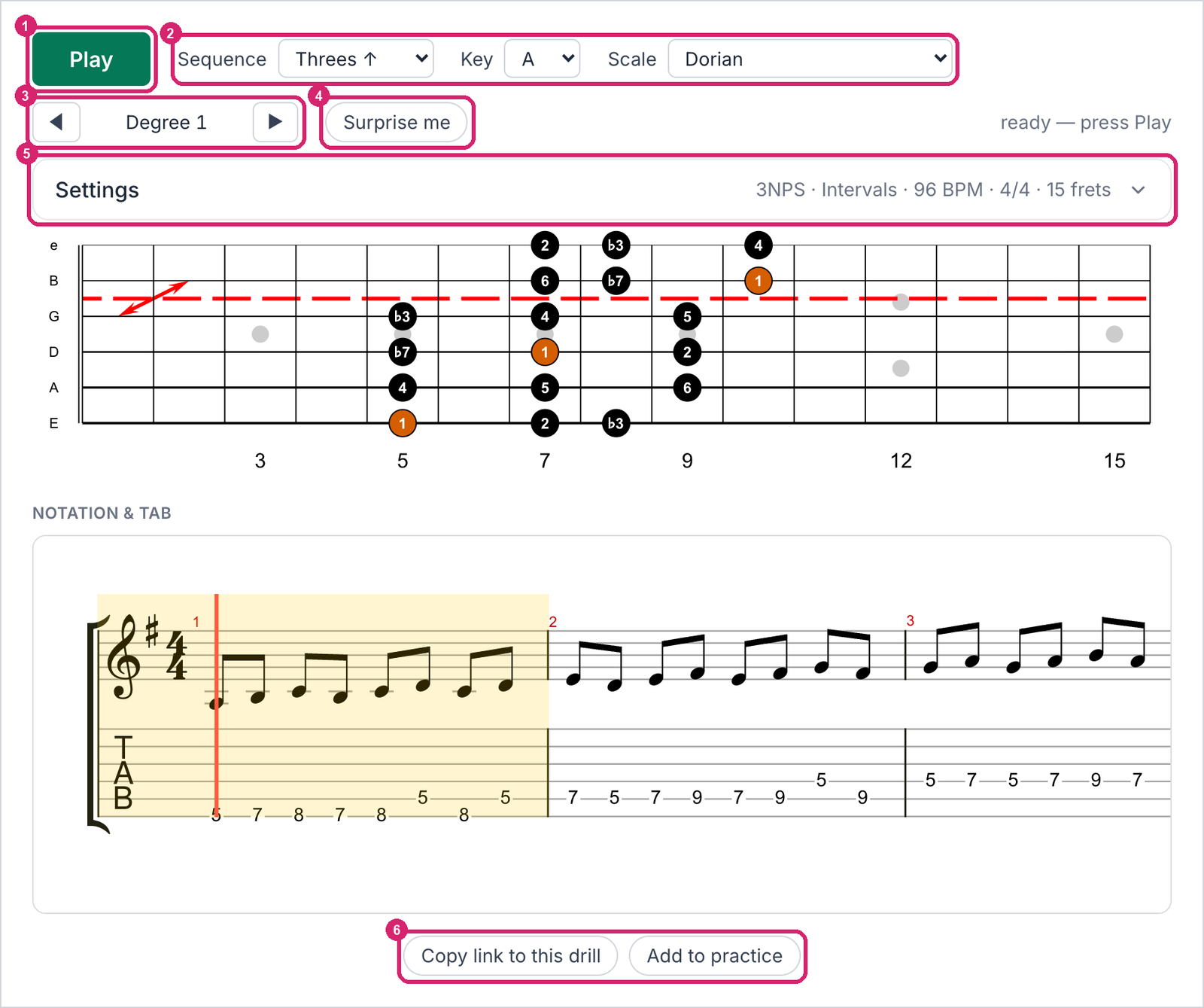
① Play and pause. ② The sequence, the key, and the scale. ③ Step through the scale's positions on the neck. ④ Surprise me picks a sequence, a subdivision, a pickup, a method, and a position for you, and keeps your key and scale. ⑤ Settings. ⑥ Copy a link to exactly what's on screen, or add it to your Practice Planner.
Press Play and the sequence loops with a drum track while the board lights each note and the notation follows along. The built-in sequences are scales, threes, fours, fives, thirds, and fourths. Each comes going up (↑), going down (↓), or up and back down (↑↓).
The position stepper walks through every place the scale fits on your board. What it calls a position depends on the method in Settings: a starting degree for 3NPS, a form for In position, and a numbered diagonal for Diagonal.
Settings
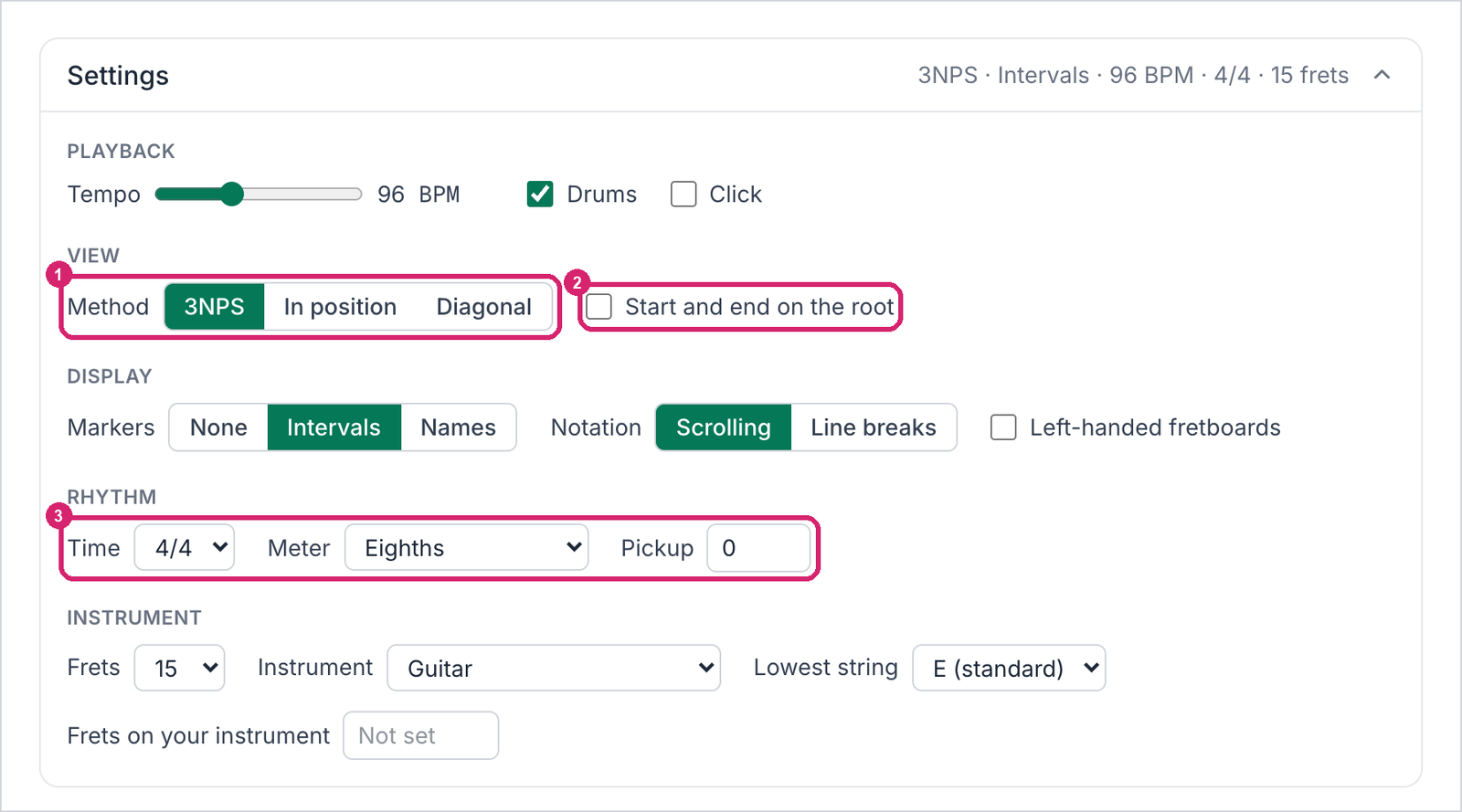
① How the scale is laid out on the neck. ② Start and end every run on the root instead of running the whole position. ③ The rhythm: the time signature, the subdivision, and the pickup.
Tempo, drums, the click, and the notation layout change while the example plays. Everything else rebuilds it.
The method decides which notes the sequence walks through, so the same sequence covers a different stretch of the neck in each one. 3NPS lays the scale out three notes per string (two in a pentatonic); In position stays inside one area of the neck; a diagonal climbs across it. This is the Visualization dial from CSF 6-6, and so are the next two: Meter is the Subdivision dial, and Pickup is the Starting point. A pickup is how many rests come before the first note, so a pickup of 1 in eighths starts every group off the beat.
Markers label the board with intervals or note names. Under Instrument you can set the number of frets, switch to a seven- or eight-string guitar or a bass, and tune the lowest string down.
Write your own sequence
Choose Custom… at the bottom of the Sequence menu. A row opens under the controls, starting from the sequence that was on screen, so Threes ↑ opens as the pattern 1 2 3 with a shift of Up 1. Change one thing and press Play.
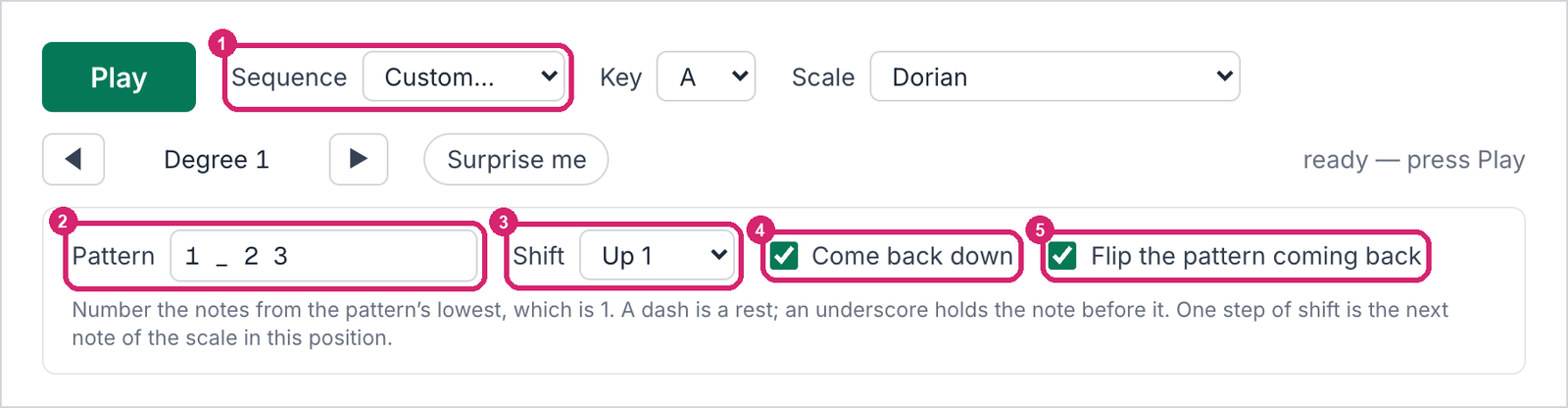
① Custom… at the bottom of the Sequence menu. ② The pattern. ③ The shift. ④ Come back down adds the return trip. ⑤ Flip the pattern coming back, on by default.
The pattern
Number the notes from the lowest one in the pattern, which is 1, the way you'd count them out loud, with a space between numbers. Every link below opens the Explorer on that pattern in A Dorian, the shape CSF Module 6 uses.
| Pattern | What it plays |
|---|---|
1 2 3 | Groups of three, the workhorse |
1 3 | Thirds |
1 4 | Fourths |
3 2 1 | Falling groups of three, while the run climbs |
3 1 2 | The notes above and below, then the one between them |
1 2 3 5 | Three steps up and a skip |
1 3 5 | The triads of the scale, one after another |
1 3 5 7 | The seventh chords of the scale |
A number counts notes of the scale in the position, not frets. In a seven-note scale, 8 is the octave. In a pentatonic, the octave is 6.
The shift
The shift is how far the pattern moves each time it repeats, Up or Down, one to four steps. One step is the next note of the scale in this position: in a pentatonic it's the next pentatonic note, and in an arpeggio it's the next chord tone. A larger shift covers ground faster: 1 2 3 4 with Up 2 plays fours that climb two notes at a time.
With a Down shift, the run starts at the top of the position and works down. The pattern and the shift are separate, so they can point in opposite directions: 1 2 3 with Down 1 plays rising groups that walk down the neck.
Rests and held notes
Each number in the pattern takes one subdivision of the meter. A dash is a rest of the same length, and an underscore holds the note before it for one more.
1 2 3 -plays three notes and a rest, so in eighths every group starts on a beat.1 _ 2 3holds the first note: in eighths, each group is a quarter note and two eighths.1 2 3 _holds the last one instead.
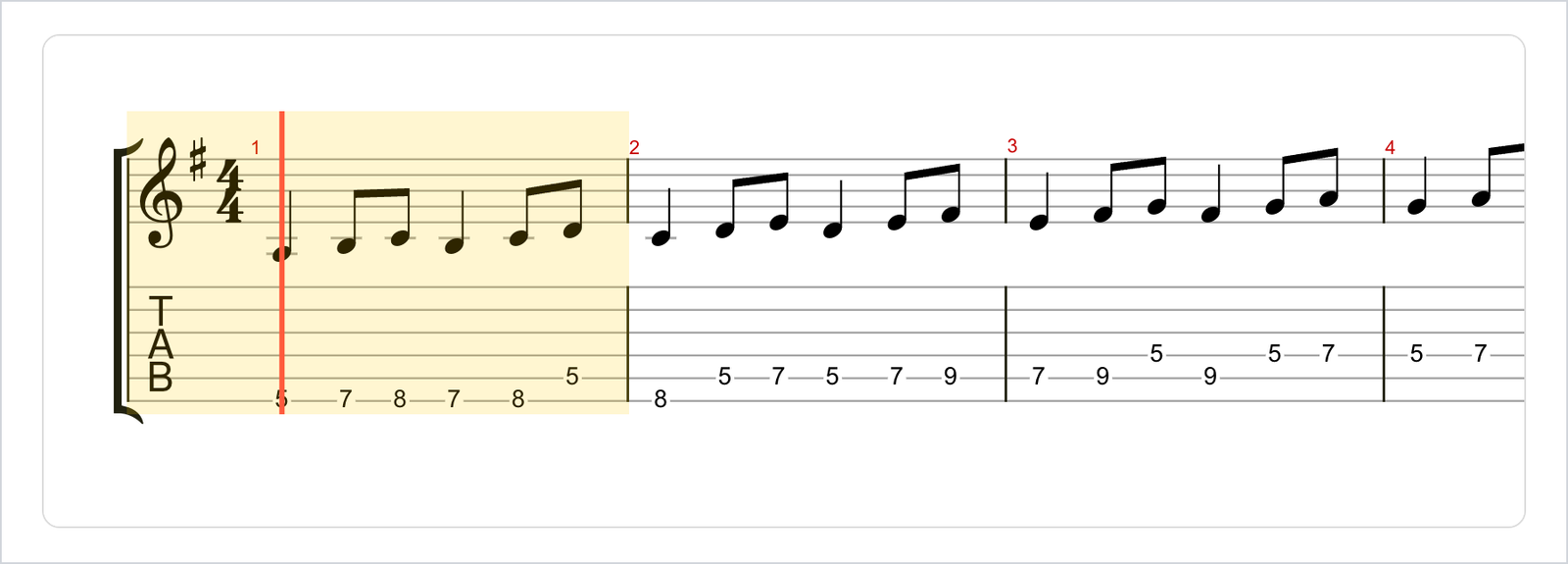
1 _ 2 3 in eighths. A held note that starts off the beat, or runs over a barline, is written as tied notes.
Coming back down
Come back down plays the run up and then back down from the top. With a Down shift it reads Come back up, and the run goes the other way.
Flip the pattern coming back turns the pattern upside down for the return, so every step up becomes a step down: 1 2 3 comes back as 3 2 1, and 1 2 3 5 as 5 4 3 1. That's how the built-in ↑↓ sequences work, and it's on by default. Turn it off and the pattern comes back as written, so the return trip plays rising groups that walk down the neck.
When a pattern doesn't fit
A pattern only plays where all of its notes fit in the position, so a wide pattern repeats fewer times. When it fits only once or twice, a line under the row says so.

① Seven notes of a pentatonic pattern. ② A shift of three. ③ The position holds twelve notes, so the pattern plays twice.
If the pattern is wider than the position, it doesn't play at all, and Play stays off until it fits. A diagonal usually holds the most notes of the three methods, so it gives a wide pattern the most room. Turning off Start and end on the root gives it the whole position.
Save and share
The address bar always holds a link to what's on screen, custom sequences included, and Copy link to this drill copies it. Add to practice puts the drill in your Practice Planner with every setting, so it opens exactly as you left it.
CSF 6-6 suggests using the Explorer two ways: listen to a combination a few times before you practice it, so you know how it should sound, and watch how it moves through a method you don't usually use, so you see how the line works before your hands do.