More yummy harmonies: spread thirds
In the last lesson, we looked at how to create harmonies from parallel 3rds and 6ths. This concept is easy to extend to wider intervals called spread thirds, and it can be used to create beautiful fingerpicked harmonies like those found in Blackbird by The Beatles.
A spread third is just a regular major or minor third interval with an extra octave added between the two notes. The root of a spread third can be played on any of the lowest three strings of the guitar, as shown in Figure 1.
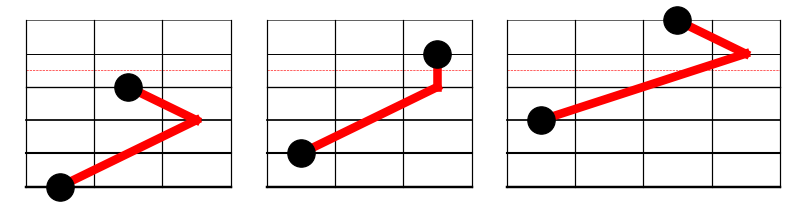
Figure 1: Spread major thirds starting from the 6th, 5th, and 4th strings, with lines showing the location of the (unplayed) octave note.
It’s straightforward to find the location of the third (played on one of the top three strings) by visualizing one octave above the lower note, and then a third above that. Just be sure to take into consideration the shift when you move from the G to the B string.
To create a spread minor third, just move the top note one fret toward the nut. Figures 2 & 3 show how the locations of the spread major and minor thirds are embedded in the familiar corresponding major and minor barre chords.

Figure 2: The top row shows a spread major third rooted on the 6th string and its corresponding barre chord. The bottom row similarly shows the minor third and minor barre chord.

Figure 3: The top row shows a spread major third rooted on the 5th string and its corresponding barre chord. The bottom row similarly shows the minor third and minor barre chord.
Example: Blackbird
The fingerpicked acoustic guitar part in The Beatles’ Blackbird is composed mostly of spread thirds played against a repeated pedal tone on the open G string. In the chorus, the guitar walks down the G Dorian scale in spread thirds, as shown in Figure 4.

Figure 4: Except from "Blackbird" consisting of parallel spread thirds walking down the G Dorian scale.
To help visualize this, Figure 5 shows the G Dorian scale on both the A and B strings.

Figure 5: The G Dorian scale on the 2nd (B) and 5th (A) strings. Major thirds are indicated with red lines, and minor thirds with blue.
In Figure 5, the numbers on the notes indicate the scale degree of the underlying Major scale. For the G Dorian mode, G notes are the second scale degree of the underlying F Major scale, so they are marked with 2. The Blackbird excerpt starts on the first scale degree (the F) and walks down to the fourth scale degree (the Bb). In the diagram, the major thirds are shown with red lines, and the minor thirds with blue.
Composing and improvising with spread thirds
To use these intervals in improvisation, keep your focus on the underlying scale degree of the lower note, and move freely within the scale on the bottom string. If the base note is the 1st, 4th, or 5th scale degree, create a spread major third. Otherwise create a spread minor third.
Once you understand this underlying principle (and assuming you can play a major scale along one string), you’ve unlocked a fun way to improvise in any of the seven diatonic modes:
- Choose the A, D, G, or B string to be your pedal tone and tonal center
- Choose two strings that are three strings apart and that surround your pedal tone to place your spread thirds
- On the lower of those strings, find the note that matches your pedal tone
- For Ionian, that note is scale degree 1; for Dorian, it’s 2; for Phrygian, 3; Lydian=4; Mixolydian=5; Aeolian=6; and Locrian=7
- Move around in the scale on the lower string, constructing the correct major or minor spread third on the fly (1, 4, & 5 are major; 2, 3, 6 & 7 are minor), and plucking the open pedal tone string
- Use the Blackbird picking pattern or make up your own
Bonus: spread triads
I based the name “spread thirds” on the concept of spread triads. In a spread triad, the middle note of a closed-form triad is raised one octave. They sound beautiful, and they’re worth exploring (and I’ll likely do another lesson on them at some point).
But for now, here is one form of spread triad that sounds great, is easy to finger, and is easy to remember as being made of a spread third plus a fifth on the string above the root.

Figure 6: One form of spread major and minor triads.
Enjoy!
Tagged: diatonic modes, harmonization
Follow along by email
The newsletter goes out every other Tuesday with what's new at Fret Science, the occasional deal, and a roundup of recent blog posts. Unsubscribe anytime.
Prefer a feed reader? Follow the blog by RSS
Discussion
Sign in or create a free account to join the discussion.
No comments yet — be the first to start the conversation.